
What is asset management business?
The asset management engage in investing client‑entrusted funds into various financial instruments—such as stocks, bonds, and investment trusts—while managing risks to preserve and grow those assets.
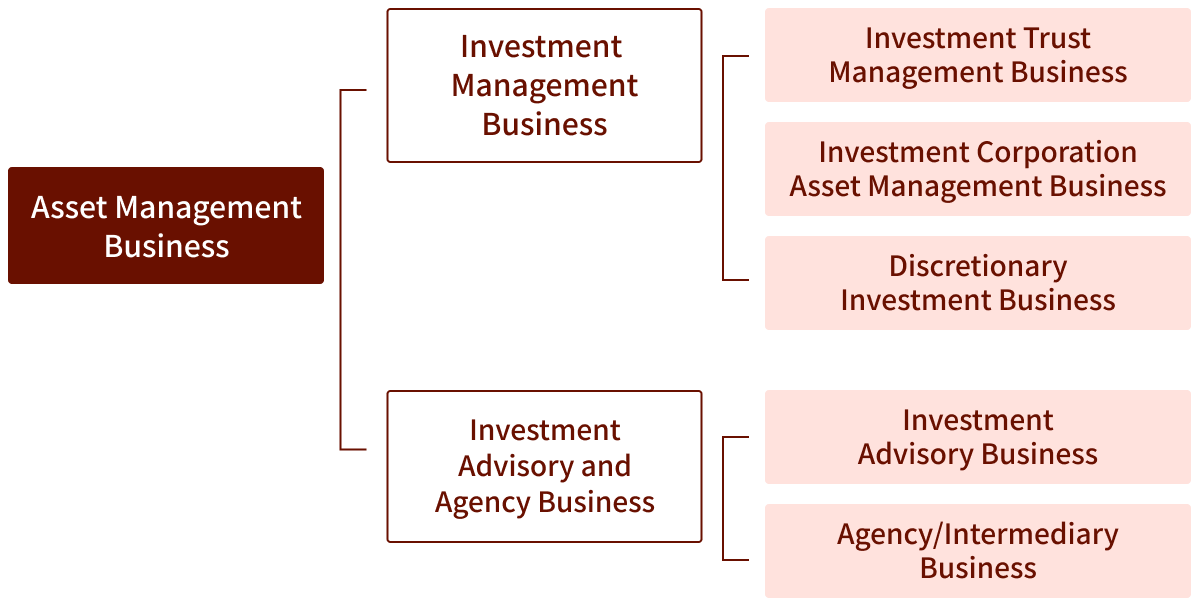
Asset management business is broadly classified into "investment management business" and "investment advisory and agency business."
To engage in these business activities, registration by the Prime Minister is required under “the Financial Instruments and Exchange Act”. Registered operators are assigned a registration number, such as “Director-General of the ○○ Local Finance Bureau (Kin-sho) No. ××××.” (○○ shows the Local Finance Bureau that has jurisdiction over the location of the head office, etc. of the applicant)
1. Investment Management Business
This category includes Investment Trust Management Business, Investment Corporation Asset Management Business, and Discretionary Investment Business.
Investment Trust Management Business
This refers to creating “investment trusts” as a financial instrument and managing the assets entrusted by investors. Companies engaged in this business are referred to as “investment trust management companies” under “the Act on Investment Trusts and Investment Corporations”, but they are also commonly called “settlor companies” or “asset management companies.”
Investment Corporation Asset Management Business
This refers to the management of funds collected by investment corporations. Because investment corporations are legally prohibited from direct asset management and other actual operations, these tasks - including asset management and custody operation - are entrusted by investment corporations to professional specialists.
Discretionary Investment Business
Under a discretionary investment contract between the investor and the asset manager, the asset manager makes investment decisions based on an analysis of the value of financial products and manages the investor's assets by investing in securities or other asset classes. This type of asset management, which is based on a discretionary investment contract, is widely used in pension funds, wrap accounts, and private real estate funds.
Role of Asset Management Companies
Asset management companies are entrusted by pension funds and life insurance companies to manage reserves such as contributions to the National Pension and Employees' Pension, as well as life insurance premiums. In this way, they indirectly support systems that are closely tied to citizens' lives, such as pensions and life insurance, making them deeply involved in the daily lives of the public.
Furthermore, asset management companies are institutional investors that handle large amounts of capital. They do not simply purchase stocks, but also engage in constructive dialogue with investee companies as shareholders, aiming to enhance corporate value. Through these activities, they strive to create a virtuous cycle in which the resulting profits are returned to the public.
2. Investment Advisory and Agency Business
This category comprises two types of services:
Investment Advisory Business
Investment advisers provide investment advice to investors based on an investment advisory contract in exchange for advisory fees. This advice is based on an analysis of the values of securities or financial products. The final investment decision should be conducted by the investor.
Agency/Intermediary Business
Under delegation from asset managers or advisory firms, agencies handle or intermediate the conclusion of discretionary investment contracts or investment advisory contracts with investors.
3. Code of conduct for confidence in Investment trusts” and “Code of ethics”
In May 2017, the former Japan Investment Trusts Association established a 10‑item Code of Conduct to ensure that investment trusts earn the confidence of a broad range of citizens and are trusted as core financial products for medium‑ to long‑term asset building.
In February 2013, the former Japan Investment Advisers Association formulated a Code of Ethics to be observed in the execution of investment advisory services.
Code of conduct for Investment Advisers